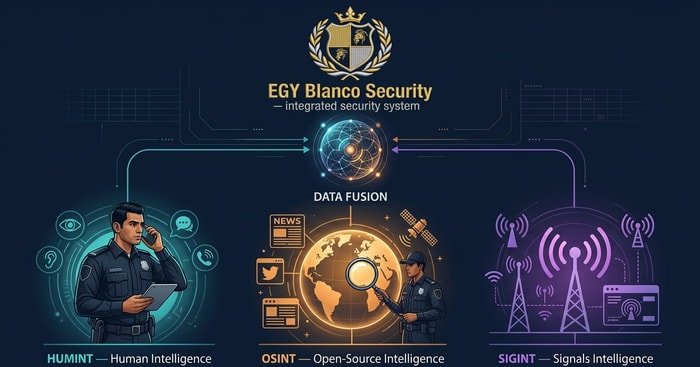
For decades, private security in Egypt operated on a reactive model: guards patrol, cameras record, alarms sound after an incident occurs. But the threat landscape has fundamentally changed. Modern adversaries—from organized crime networks to cyber-physical attackers—operate with intelligence, planning, and coordination. Egyptian security providers are responding by adopting an entirely different paradigm: intelligence-led security, where data, analysis, and prediction drive every operational decision.
This comprehensive guide examines what intelligence-led security means for the Egyptian market, how it differs from traditional guarding, the key intelligence disciplines involved (HUMINT, OSINT, SIGINT), how SOC integration creates a unified operational picture, and a practical roadmap for Egyptian security companies to build intelligence capabilities.
1. Reactive vs. Proactive vs. Predictive Security
Understanding the three security operating models is essential to grasping why intelligence-led security represents a fundamental shift.
Reactive
Model: Respond after an incident occurs
- Guards at fixed posts
- CCTV recording for evidence
- Alarm triggers response
- Incident reports after the fact
Limitation: Damage is already done before response.
Proactive
Model: Deter and detect before an incident
- Visible deterrence through presence
- Real-time monitoring & response
- Perimeter hardening
- Vulnerability assessments
Limitation: Still waits for the threat to appear.
Predictive
Model: Anticipate and prevent before threat materializes
- Threat intelligence gathering
- Pattern recognition & anomaly detection
- Predictive analytics
- Pre-emptive resource deployment
Advantage: Threats are neutralized before impact.
2. The Three Intelligence Disciplines in Private Security
Intelligence-led security draws on three complementary intelligence disciplines, each contributing a distinct type of insight to the security operation.
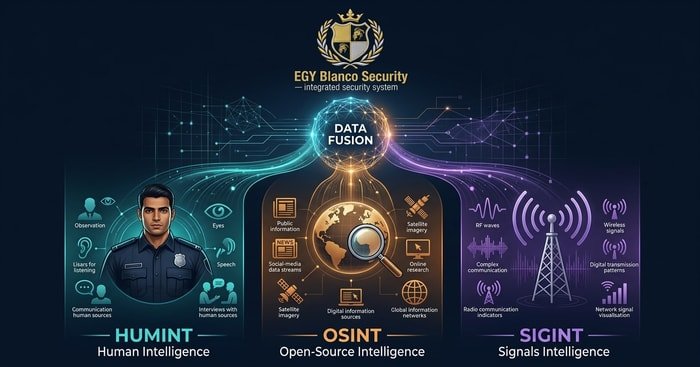
Key Intelligence Disciplines:
- HUMINT (Human Intelligence): Information gathered by trained personnel through observation, interviews, and source networks. Vital for understanding local threat actors, insider risks, and community dynamics around facilities.
- OSINT (Open-Source Intelligence): Analysis of publicly available information—social media, news reports, business registries, satellite imagery. Used for pre-operational reconnaissance, VIP movement tracking, and reputation monitoring.
- SIGINT (Signals Intelligence - limited private use): In private security, this refers to monitoring communication patterns and RF anomalies at facilities, not interception of content.
- Data Fusion: Combining insights from all disciplines into a unified operational picture—no single discipline provides complete intelligence.
Professional intelligence-led security operations require trained analysts and disciplined collection methodologies.
3. SOC Integration: The Operational Backbone
Intelligence without operational integration is academic. The Security Operations Center (SOC) is where intelligence becomes action—where analysts, technology, and field teams converge.
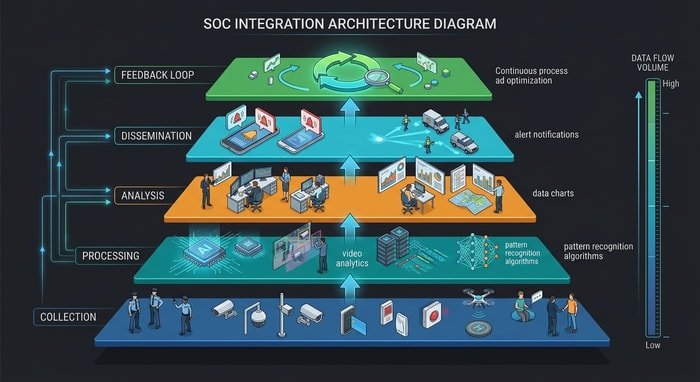
SOC Integration Layers:
- Collection Layer: Field guards, CCTV, access control, alarm systems, drones, HUMINT sources, and OSINT feeds.
- Processing Layer: AI anomaly detection, video analytics, pattern recognition, and alert triage.
- Analysis Layer: Trained intelligence analysts assess threats and produce actionable intelligence.
- Dissemination Layer: Push alerts, mobile apps, and direct communication to field teams and client executives.
- Feedback Loop: Post-incident analysis improves future detection models.
SOC integration transforms isolated security systems into a unified, responsive operational network.
4. Practical Applications in the Egyptian Market
Intelligence-led security is not theoretical—it has concrete applications across Egypt's most security-sensitive sectors.
Sector-Specific Applications:
- Banking & Finance: OSINT monitoring of branch locations for protest coordination or social media threats; HUMINT in high-risk areas; predictive modeling for cash-in-transit routes. Explore banking security.
- Corporate Campuses: Insider threat detection through behavioral analysis and HUMINT; supply chain threat monitoring; executive movement pre-planning. Corporate guarding.
- Industrial Facilities: OSINT for activist targeting of plants; HUMINT among local communities; predictive cyber-physical threat modeling. Industrial security.
- VIP Protection: Movement pattern analysis, route risk scoring, digital footprint monitoring of potential threats. VIP protection.
- Real Estate & Compounds: Community intelligence for resident safety; predictive modeling of crime patterns; tenant screening intelligence. Residential security.
Real-World Scenarios:
Scenario 1 — Event Security:
Before a large public event, OSINT analysis identifies coordinated social media calls for disruption. HUMINT sources verify the threat's credibility. The event security plan is adjusted—additional guards at specific entry points, revised evacuation routes. Threat neutralized before it materializes.
Scenario 2 — Executive Protection:
Continuous OSINT monitoring detects a hostile post on social media referencing an executive's upcoming public appearance. Analysis reveals pattern of previous aggressive behavior. Security detail is enhanced, route is altered, and the appearance proceeds without incident.
Scenario 3 — Industrial Facility:
HUMINT network in the local community reports unusual observations near a plant perimeter. Cross-referenced with CCTV anomaly detection and vehicle license plate recognition, a surveillance operation is identified and disrupted before any physical breach.
5. Building Intelligence Capabilities: A Practical Roadmap
Egyptian security companies can build intelligence-led capabilities through a phased approach that balances investment, training, and technology.
Implementation Roadmap:
- Phase 1 — Baseline Assessment: Evaluate existing capabilities, identify critical intelligence gaps, and prioritize use cases aligned with client needs.
- Phase 2 — OSINT Foundation: Establish OSINT monitoring protocols, train analysts in open-source collection techniques, and deploy social listening and news monitoring tools.
- Phase 3 — HUMINT Development: Train field personnel in observation, reporting, and source cultivation. Build community liaison programs in high-risk areas.
- Phase 4 — Technology Integration: Deploy SOC platform with AI analytics, integrate CCTV and access control data, and connect field teams through mobile apps.
- Phase 5 — Analytical Maturity: Hire or train dedicated intelligence analysts, establish analyst-field feedback loops, and institutionalize predictive modeling.
- Phase 6 — Continuous Improvement: Regular tabletop exercises, red team simulations, and post-incident analysis to refine intelligence tradecraft.
6. Challenges & Ethical Considerations in Egypt
Intelligence-led security in Egypt operates within a specific legal and cultural context that must be respected.
- Legal Boundaries: Private security companies must operate strictly within Egyptian law. HUMINT must be collected openly and ethically; SIGINT operations are reserved for state authorities.
- Privacy Compliance: All OSINT and HUMINT activities must comply with Egypt's Personal Data Protection Law (Law No. 151 of 2020). View our privacy policy.
- Ethical Framework: Intelligence must serve protective purposes only—never targeting individuals unfairly, never used for competitive advantage against other businesses.
- Skills Gap: Egypt needs trained security intelligence analysts. Investment in training programs and partnerships with universities is essential.
- Client Education: Many Egyptian clients are not yet familiar with intelligence-led security. Providers must educate them on the value and ROI of predictive protection.
Conclusion: The Future of Egyptian Private Security
Intelligence-led security is not a passing trend—it is the future of professional security in Egypt and globally. As threats become more sophisticated, more coordinated, and more digital, Egyptian security providers who master intelligence tradecraft will differentiate themselves from competitors still operating on reactive models.
At EGY Blanco Security, we are investing in intelligence capabilities to protect our clients across Egypt—from Cairo and Alexandria to the New Administrative Capital and beyond. Contact us to discuss how intelligence-led security can transform your organization's protection strategy.
2026 Intelligence-Led Security Checklist for Egyptian Organizations:
- Assess current security maturity: reactive, proactive, or predictive?
- Identify intelligence requirements specific to your threat profile.
- Establish OSINT monitoring protocols for facility and executive digital footprints.
- Train field guards in observation and reporting standards (HUMINT fundamentals).
- Integrate data sources (CCTV, access control, alarms) into a unified SOC.
- Hire or develop intelligence analyst capability.
- Partner with security providers who can offer intelligence-led services.
- Ensure all intelligence activities comply with Egyptian PDPL (Law 151/2020).
Ready to move beyond reactive security? Contact EGY Blanco Security for an intelligence readiness assessment.