Hospitals and healthcare facilities present a unique security challenge unlike any other facility. They are open to the public 24/7, contain high-value assets including pharmaceuticals and equipment, and receive people in critical physical and psychological conditions. In Egypt 2026, with the massive expansion of the healthcare sector—from the Universal Health Insurance project to new hospitals in the New Administrative Capital and smart cities—securing these facilities has become a national and investment priority. According to data from the World Health Organization (WHO), healthcare facilities require specialized security plans that differ fundamentally from commercial or industrial buildings.
1. Securing Emergency and Reception Departments: The First Line of Defense
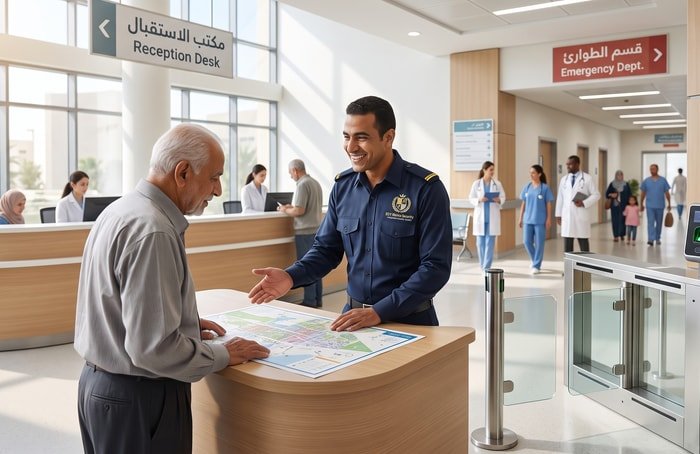
The emergency department is the most tense and vulnerable point in any hospital. It receives unexpected cases, companions in a state of nervous breakdown, and may be a target for violence or theft. Security here must combine visible and invisible presence. The American Hospital Association (AHA) report recommends at least one trained security officer in the emergency department during all operating hours. Learn about hospital security services specifically designed for this sensitive environment.
2. Protecting Hospital Pharmacy and Drug Warehouses: Assets Worth Millions
Pharmaceuticals—especially narcotics, psychiatric, and chemotherapy drugs—represent a prime target for internal and external theft. The hospital pharmacy must be a high-security zone, with access control systems limited to authorized pharmacists only, and real-time logging of every dispensing operation. Surveillance cameras must cover every angle without blind spots, with recordings retained for no less than 90 days.
3. Crowd and Visitor Management: The Balance Between Welcome and Safety
Unlike a bank or factory, a hospital cannot close its doors or deny entry. But unorganized visitors cause congestion, disrupt medical work, and may include individuals exploiting the chaos. The solution lies in a disciplined visitation policy enforced by security personnel trained in both courtesy and firmness. Electronic visitor badge systems through integrated security solutions enable tracking of every visitor from entry to exit.
4. Securing High-Value Medical Equipment: Million-Pound Devices Need Protection
MRI machines, CT scanners, and surgical robots represent investments of millions of Egyptian pounds. Theft or vandalism of these devices not only causes material loss but disrupts entire medical services. Alarm systems linked to surveillance cameras provide immediate protection, with electronic seals on fixed equipment that detect any tampering attempts.
5. Emergency and Evacuation Plan: When Seconds Make the Difference
Fire, power outage, or natural disaster—in a hospital, you cannot simply "evacuate the building." There are patients on ventilators and ongoing surgical operations. The emergency plan must include graduated horizontal and vertical evacuation procedures and safe zones within the building itself. Quarterly joint drills between medical staff and static security personnel ensure coordinated and rapid response.
6. Training Security Personnel to Handle Patients: Skills Beyond Strength
A security officer in a hospital needs completely different training from any other site. They deal with patients in pain, their families in extreme anxiety, and doctors under immense pressure. They must master conflict de-escalation skills, basic first aid, and understanding of medical information confidentiality. In sensitive security operations management, we focus on qualifying specialized security personnel for the healthcare sector.
7. Cybersecurity for Hospital Systems: Protecting Data and Connected Medical Devices
In the era of smart hospitals, ICU beds and cardiac monitoring devices are connected to the internet. Any breach of these systems threatens not only data but directly endangers patient lives. Medical IT systems must be protected at the same level as physical security systems. The European Union Agency for Cybersecurity (ENISA) report indicates that 60% of cyberattacks on hospitals target connected medical devices, not just data.
Hospital Security Checklist: 8 Points You Cannot Ignore
- Is there a trained security officer in the emergency department during all operating hours?
- Are the hospital pharmacy and narcotic drug warehouses secured with biometric access systems?
- Is there a clear policy for issuing and tracking visitor badges?
- Are all high-value medical devices electronically sealed?
- Is there a hospital-specific emergency evacuation plan that has been recently drilled?
- Have security personnel received conflict de-escalation and first aid training?
- Are IT systems and connected medical devices cyber-protected?
- Do surveillance cameras cover all entrances, exits, and main corridors?
Hospital security is not a luxury or a secondary budget item—it is an essential component of healthcare quality itself. A secure hospital means reassured patients, a medical staff able to focus on their work, protected assets, and a strong institutional reputation. At EGY Blanco Security, we pride ourselves on providing specialized security solutions for healthcare facilities that combine professional security with the human sensitivity this unique sector demands. Contact us today for a free security assessment of your medical facility.